

Encores! High Spirits
The inciting incident in the musical High Spirits is a séance that occurs because of a curious novelist’s interest in learning what he calls “the tricks of the trade,” as research for a character in his book. What begins as a seemingly harmless demonstration for a group of skeptics quickly turns Charles Condomine’s world upside down, upside down, when Madame Arcati’s séance summons the ghost of his late first wife.
But what exactly are “the tricks” and what is “the trade” that Charles is initially referring to? And how did the occult become such an enduring part of Western culture?
SPIRITUALISM
Throughout history, living people have sought to communicate with the dead, either for entertainment or to comfort those grieving a loss. But the practice of contacting the dead through séances—like the one in High Spirits—didn’t take shape until the spiritualism movement first emerged.
Spiritualism was a belief system and social movement that developed in America and Europe during the mid-1800s. Followers believed that death was not the end of existence, and that the spirits of the dead could communicate with the living. One of the strongest influences on the growth of spiritualism was the American Civil War (1861–1865), the deadliest conflict in US history. In its aftermath, millions of people were grieving and searching for ways to cope with the loss of loved ones.
Spiritualism first became popular at a time when illness, war, and lower quality of life made death a much more familiar part of everyday experience than we might think of it today. The movement tended to resurface during periods of widespread hardship. During the 1920s, the movement gained momentum again, motivated by the devastating aftermaths of both World War I and the 1918 flu pandemic. It surged again in the mid-20th century after World War II, around the time that Blithe Spirits and High Spirits were written.
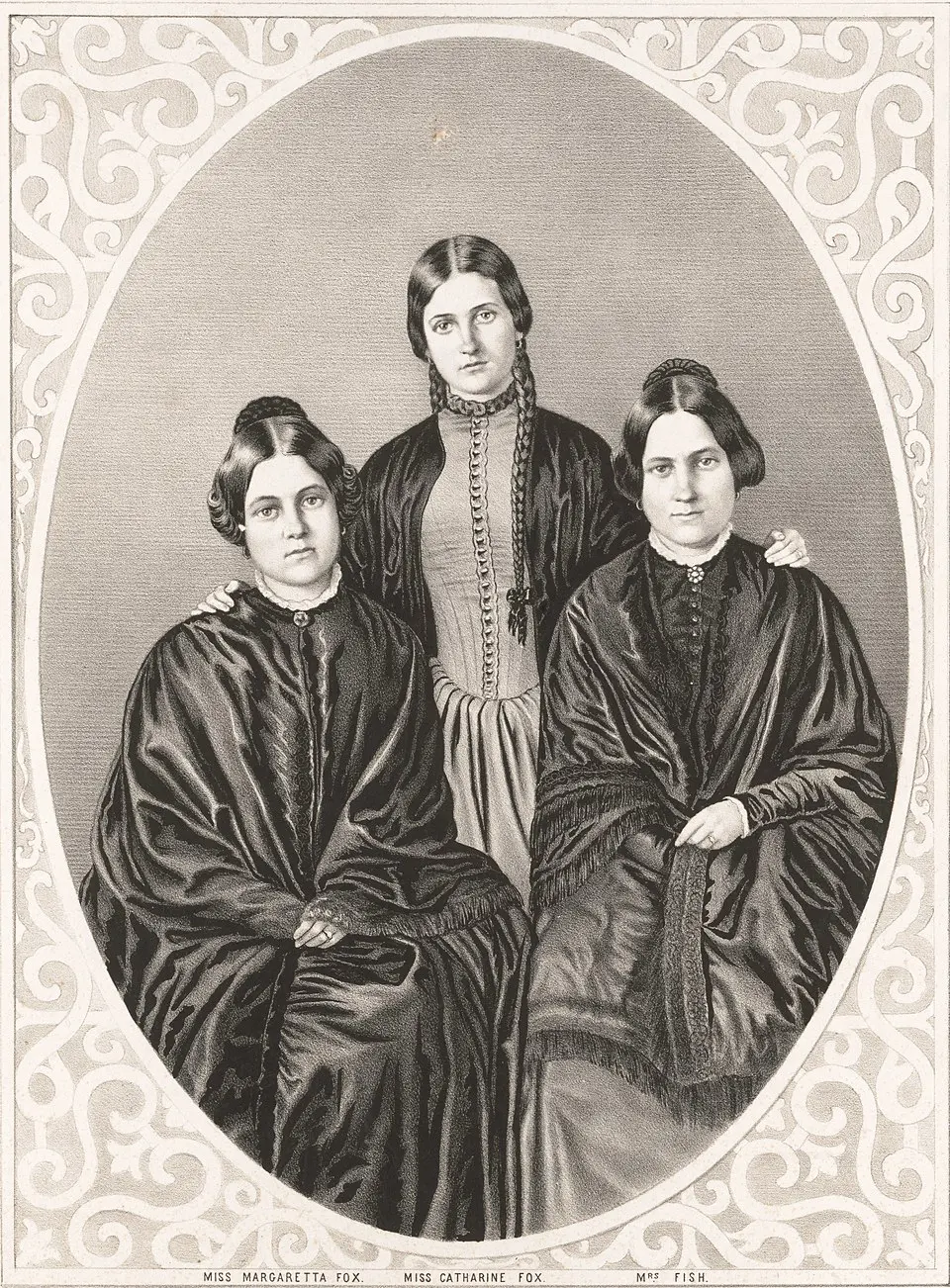
The Fox sisters, famous 19th-century mediums
Central to spiritualism was the belief that the human consciousness survives after physical death, and that these consciousnesses could send messages to the living. These messages were typically channeled through a medium, like Madame Arcati in High Spirits. A medium was a person believed to have special abilities to communicate with the spirit world—someone who could mediate conversations between the living and the dead. Often these conversations took place during a séance.
THE SÉANCE
Séances were a key part of spiritualist practice. The word séance comes from the French word meaning ‘to sit.’ A séance involved a group of people sitting, usually in a circle, and typically in dim light or complete darkness. High Spirits begins its story with such a gathering, though not all the characters take it seriously. These gatherings followed strict rituals and rules that were believed to create the best conditions for spirit communication.
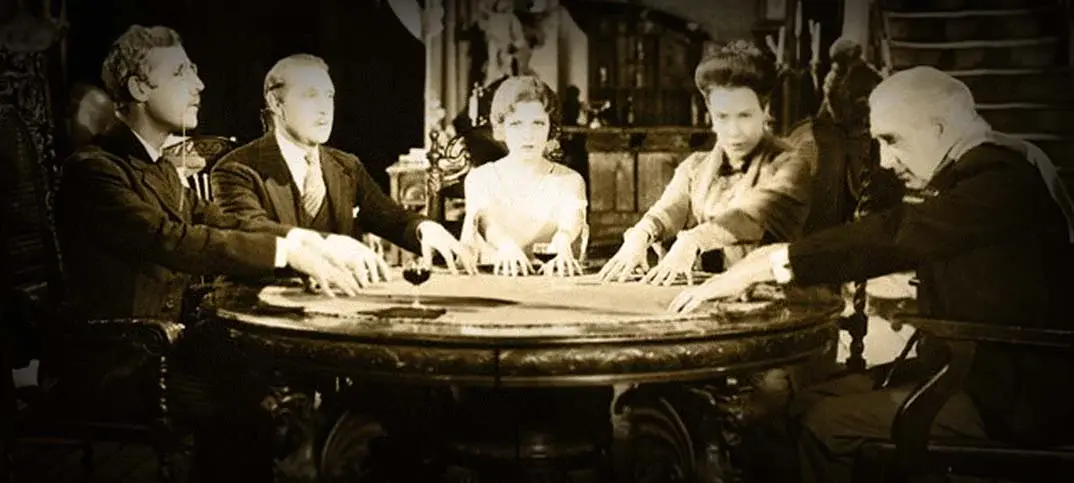
A typical seance, c. 1940s
Methods used include table tipping (a table shakes or levitates in response to spirits), spirit trumpets (hollow cones that were said to amplify the whispered voices of spirits), automatic writing (in which a medium’s hand was guided by an unseen force, appearing to write messages without conscious control), and rappings (knocks or taps that responded to yes or no questions—this is the method employed by Madame Arcati). These practices helped inspire tools, traditions, and even movies that are still famous today.
OUIJA BOARD
One tool (or “trick” as Charles might call it) employed in spiritualism is the Ouija board. In High Spirits, Madame Arcati consults her Ouija board in the song “Talking To You,” and discovers that Ruth has been killed by Elvira. The Ouija board was developed in the late 1800s, inspired by the practice of automatic writing. It allowed users to ask questions and receive answers spelled out by a moving pointer called a planchette. The board includes letters, numbers, and simple responses like “yes” and “no.”
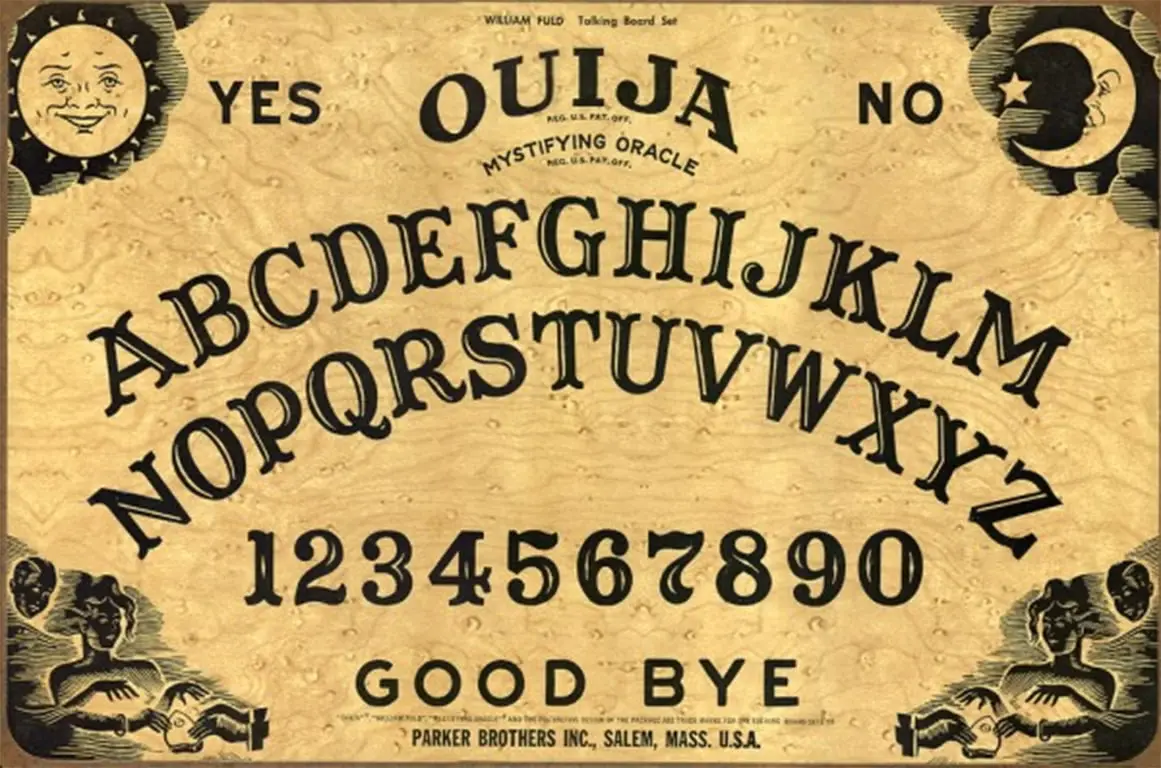
The Ouija board
Charles Kennard, an entrepreneur, and E.C. Reiche, a coffin maker/undertaker, first debuted their “talking board” in Baltimore in 1886, inspired by the growing popularity of the spiritualist movement. They were later joined by lawyer Elijah Bond, whose sister, Helen Peters, was a successful medium. She coined the name ‘Ouija’ by asking the board to spell out its name. She claimed it meant ‘good luck,’ but it was later discovered that those letters were on the locket she was wearing that day.
The Ouija board became popular among spiritualists and was marketed for casual use by its next owners, the Fuld family. In 1966, it was acquired by Parker Brothers and sold as a board game. It was not until the 1973 film The Exorcist that the Ouija board gained a broadly sinister reputation—a reputation that sticks to this day. Since High Spirits premiered on Broadway in 1964, audiences at the time likely did not associate the Ouija board with horror in the same way modern viewers do.
CRYSTAL BALL
Another tool (or “trick”) employed in spiritual pursuits is the crystal ball. Madame Arcati uses a crystal ball at the end of the play to determine who really summoned Elvira in the first place. The crystal ball is one of the most ancient tools in divination, the practice of seeking hidden knowledge about the future or unknown entities through supernatural or occult means.
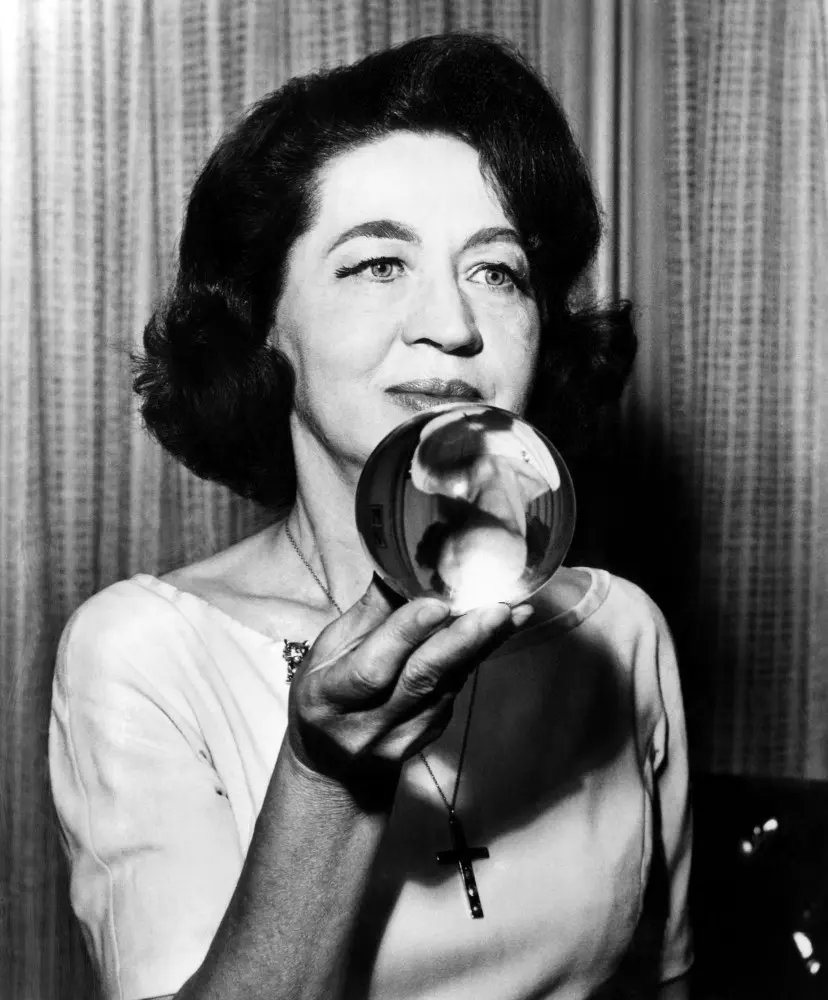
Jean Dixon, crystal ball counselor
Thousands of years ago, the Celtic Druids (often associated with Stonehenge) used polished stones for scrying, a method of divination which involved looking into reflective surfaces to receive visions or messages. In the Middle Ages, crystal balls became symbols of not only magic and wisdom, but also of power and status. During the rise of spiritualism, crystal balls were often used by fortune-tellers and mediums as tools to focus the mind and connect with the spirit world.
In the 1950s, a high-profile crystal ball counselor named Jeane Dixon became famous for her political predictions. Most famously, in 1956 she correctly predicted that a Democratic president would be elected and then assassinated—a prediction many connected to the election of John F. Kennedy in 1960 and his assassination in 1963. These events may have been fresh in the minds of the writers of High Spirits, given the time period.
SPIRITUALISM TODAY
Examining spiritualism gives us a window into how people across history have tried to understand life, death, and what might lie beyond. Objects like the Ouija board and crystal ball reflect humanity’s curiosity and desire for connection, especially during times of loss, fear, or uncertainty. While beliefs about spirits have changed, these symbols remain powerful reminders of how science, psychology, culture, and imagination often overlap.
Understanding spiritualism helps us better understand the past—and why certain mysterious ideas still capture our attention today.